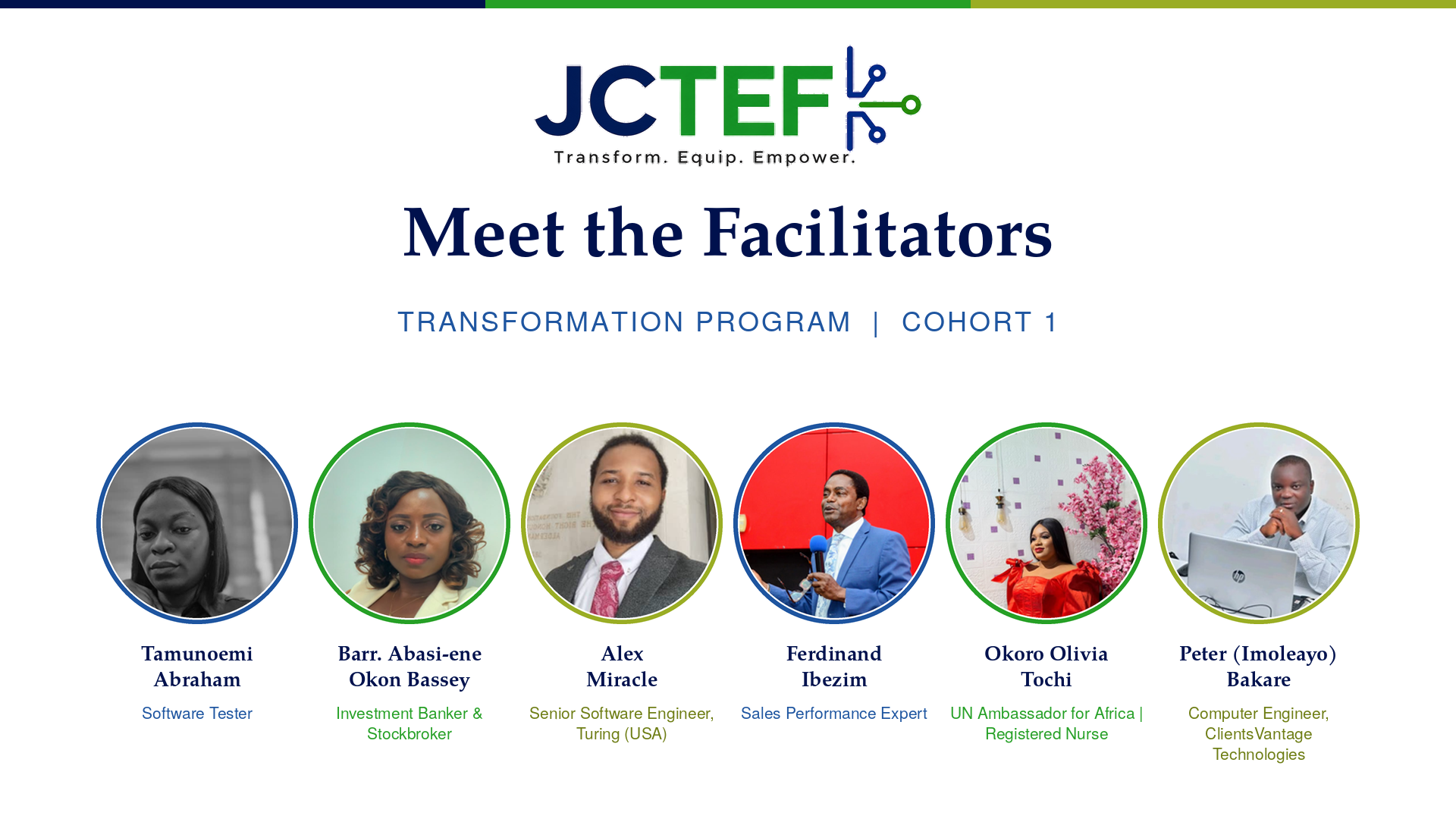
JCTEF Transformation Programme | Cohort 1
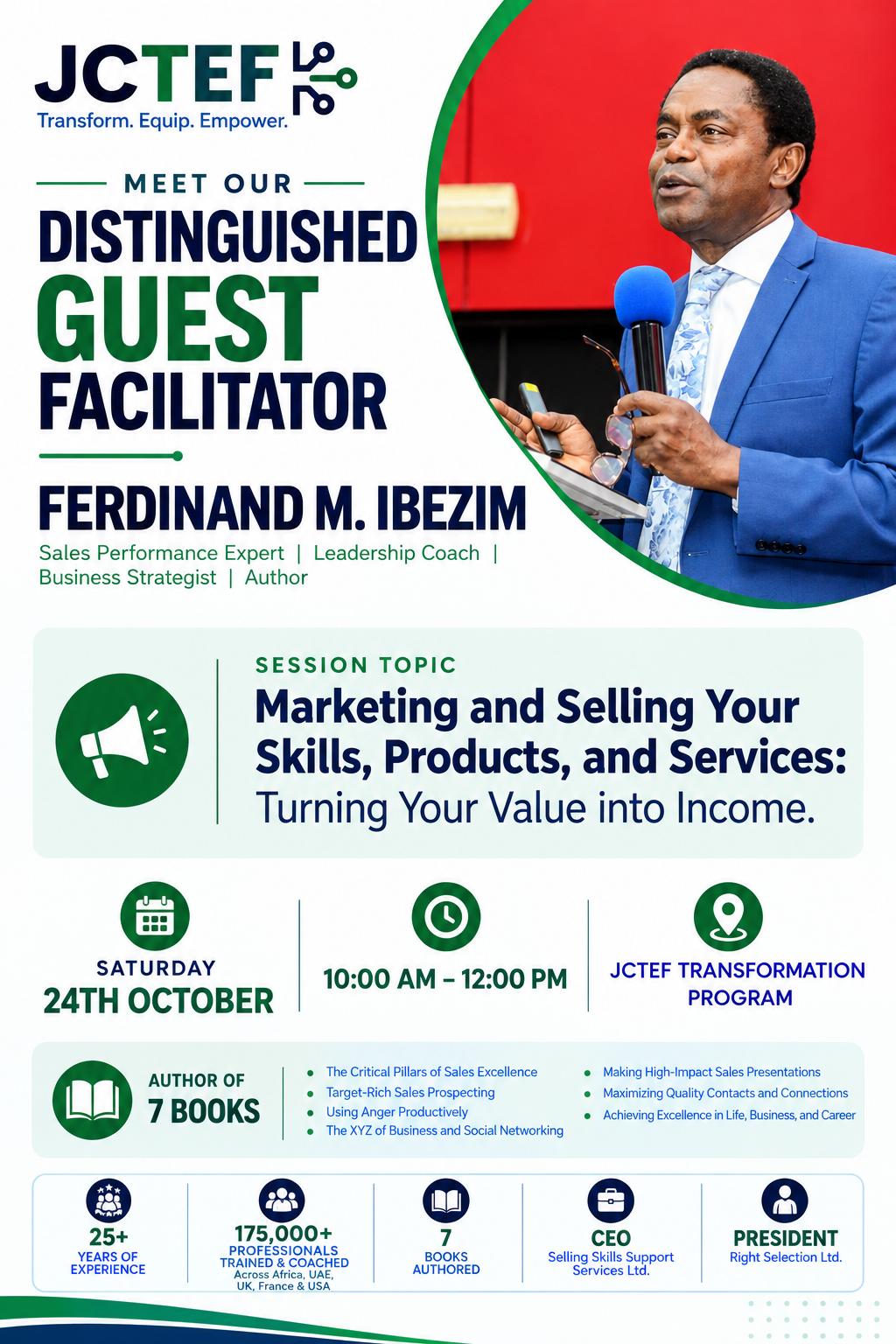
Session Date: 24 October 2026
Guest Facilitator: Mr. Ferdinand Ibezim
Session Theme: Marketing and Selling Your Skills, Products, and Services: Turning Your Value into Income
Introduction: Having Value Is Not Enough
Having value is one thing. Knowing how to communicate it, position it, and turn it into income is another.
On Saturday, 24 October 2026, Fellows of the Jacob Chidimma Empowerment and Transformation Foundation (JCTEF) Transformation Programme participated in an impactful session on Marketing and Selling Your Skills, Products, and Services: Turning Your Value into Income, facilitated by Mr. Ferdinand Ibezim.
The session explored the principles of selling, the importance of personal presentation, the role of perception in value creation, and the power of relationships and networking in building successful careers and businesses.
For the Fellows, the conversation extended beyond conventional marketing techniques. It challenged them to think differently about how they present themselves, communicate their capabilities, build professional relationships, and create opportunities from the value they possess.
Understanding the Eight Pillars of Selling
During the session, Mr. Ibezim introduced the Fellows to the eight pillars of selling, providing a framework for understanding the different factors that influence a person’s ability to sell a product, service, or skill.
A central lesson was that selling is not simply about having something valuable to offer. It also involves developing the competence, personality, communication ability, and professional presence required to convince others of that value.
Every profession, product, or service requires a certain level of competence and a particular approach to presentation. How a person communicates, behaves, presents themselves, and engages with potential customers can influence how their offering is perceived.
This is especially important for young people who are developing their careers, building businesses, or seeking opportunities to monetize their skills.
Technical ability is important, but the ability to communicate that ability effectively is equally valuable.
A person may possess an excellent skill, but if they cannot explain what they do, demonstrate its relevance, or help others understand the problem they can solve, their opportunities may remain limited.
The lesson was clear: developing value must go hand in hand with learning how to communicate and sell that value.
Perception: How People Understand the Value You Offer
One of the most striking lessons from the session was the importance of perception.
Mr. Ibezim emphasized that perception plays a significant role in how people evaluate and validate the value of a product, service, or professional offering.
People do not always make decisions based solely on the technical qualities of what is being offered. Their understanding of its value is also influenced by how it is presented, communicated, and experienced.
This means that individuals and businesses must be intentional about the perception they create around their offerings.
For a professional, this may involve communicating expertise clearly, demonstrating reliability, presenting work professionally, and building a reputation for delivering results.
For an entrepreneur, it may involve explaining the benefits of a product, understanding customers’ needs, and communicating how the product solves a problem.
However, creating a positive perception must go beyond appearances. Sustainable trust requires competence, integrity, consistency, and the ability to deliver on promises.
The objective is not merely to look valuable, but to communicate genuine value in a way that others can understand, appreciate, and trust.
Visibility Matters: Do Not Stay Hidden
Another memorable statement from the session was:
“If you mind your business too long, very soon you will have no business to mind.”
The statement challenged the idea that having a good product, possessing a valuable skill, or doing excellent work privately is enough to guarantee success.
People need opportunities to discover what you do, understand what you offer, and experience the value you bring.
A talented software developer needs to communicate their capabilities to potential employers or clients. An entrepreneur needs to reach people who may benefit from their product. A professional needs to build a reputation that reflects their competence.
In each case, visibility helps connect value with opportunity.
This does not mean that people must constantly promote themselves without purpose. Rather, they must learn to communicate their work strategically, build credibility, share relevant achievements, and make it easier for the right people to discover them.
The ability to market oneself is therefore an important part of personal and professional development.
Your Business Needs People Who Know What You Offer
Mr. Ibezim also highlighted the relationship between awareness and business growth, emphasizing that a business needs people who know about it.
A business may have an excellent product or service, but its potential customers must first become aware of its existence. They must also understand what it offers and why it may be relevant to their needs.
This makes marketing an essential part of business development rather than an activity reserved for businesses that are struggling to find customers.
For young entrepreneurs and aspiring professionals, this lesson reinforces the importance of learning how to communicate their value proposition, build trust, develop a professional network, and reach their intended audience.
Value creates potential, but effective communication helps connect that value to the people who need it.
The Power of Relationships and Networking
Towards the end of the session, Mr. Ibezim addressed another important factor in personal and professional growth: relationships and networking.
He emphasized the importance of the people who know you, the relationships you build, and the networks through which opportunities can emerge.
One of the memorable ideas from the discussion was that the quality of a person’s life can be influenced by the quality of the people who know them.
This points to an important reality: personal and professional development does not happen in isolation.
Relationships can provide access to knowledge, mentorship, collaboration, referrals, career opportunities, and new perspectives. A meaningful professional connection can introduce someone to an opportunity they might not have discovered independently.
However, networking is not simply about collecting contacts or knowing influential people. Effective networking involves building genuine relationships, contributing value, maintaining trust, and creating mutually beneficial connections.
For young people, developing relationship capital means learning to connect meaningfully with others, communicate professionally, follow up on conversations, and nurture relationships over time.
This part of the session was particularly significant because it connected directly with one of the foundational stages of the JCTEF Transformation Programme: Relationship Capital.
Connecting the Session to the JCTEF Transformation Programme
At JCTEF, we believe that human capital development must go beyond helping people acquire technical skills.
Our Transformation Programme was designed around the understanding that sustainable personal and economic transformation requires the development of the whole person.
The programme’s eight stages are:
- Self-Discovery — Understanding one’s identity, strengths, values, beliefs, and potential.
- Mental Fitness — Developing emotional regulation, resilience, and the mindset needed to navigate life’s challenges.
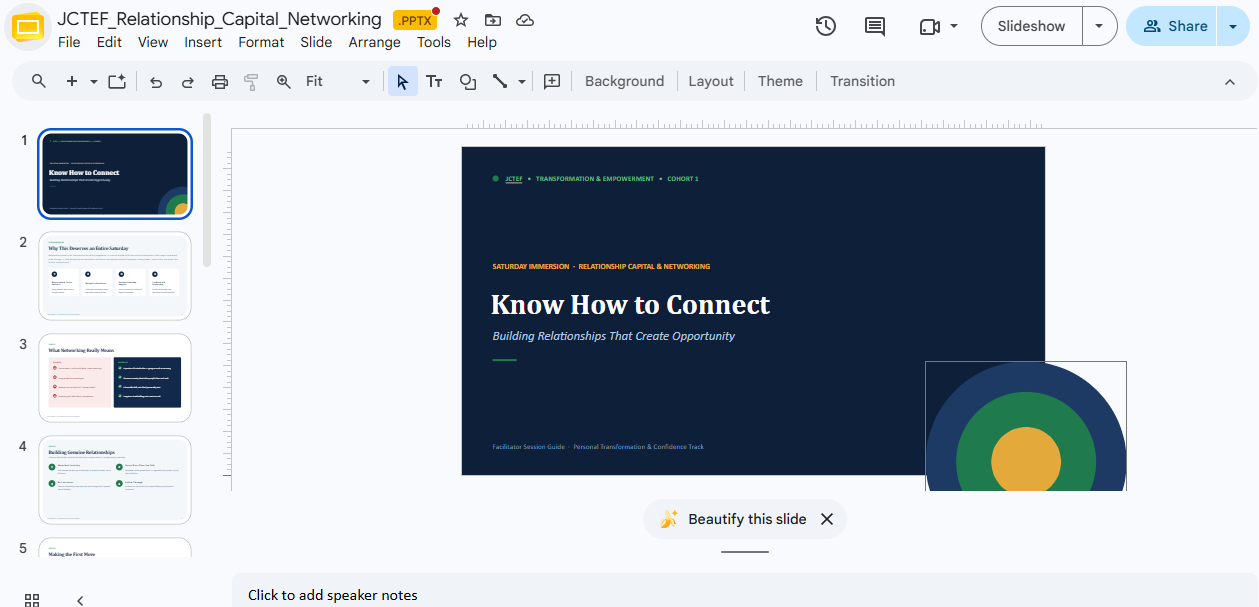
- Relationship Capital — Building meaningful relationships and learning to create value through professional and personal networks.
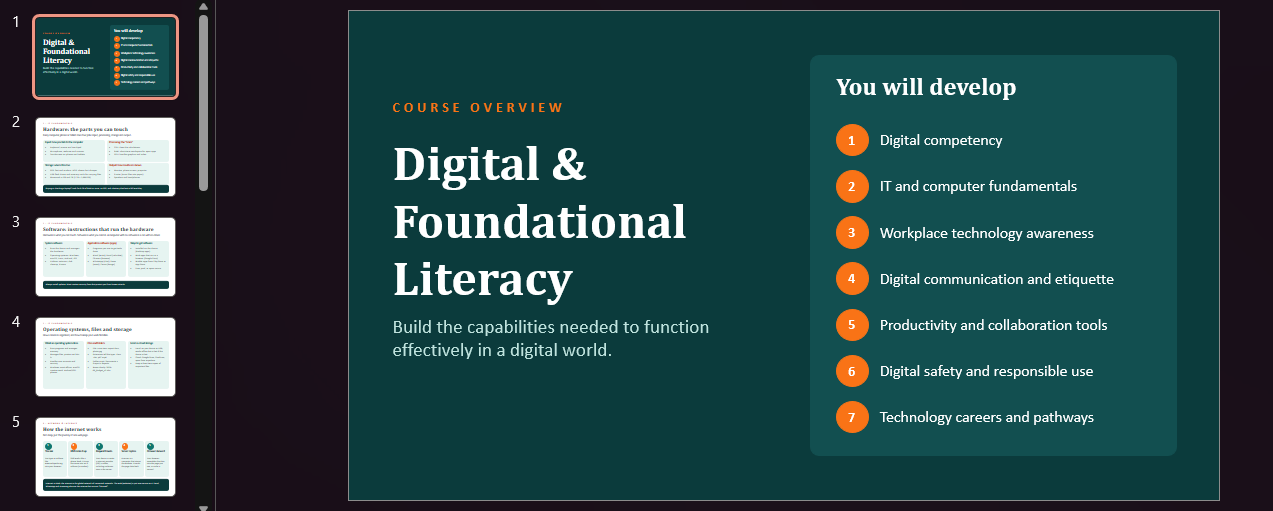
- Digital Literacy — Developing the digital awareness and competencies required to participate effectively in an increasingly digital world.
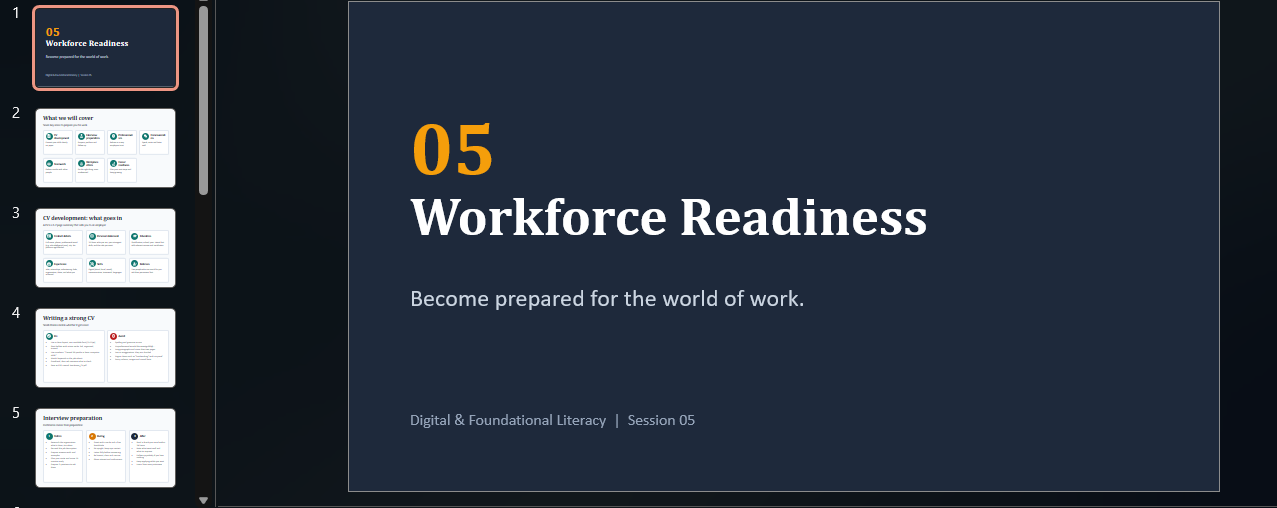
- Workforce Readiness — Preparing for the expectations, responsibilities, and demands of the workplace.
- Financial Literacy — Learning to make informed financial decisions and manage money responsibly.
- Marketable Skill Development — Developing relevant skills that can solve problems and create value.
- Economic Placement — Connecting personal capacity and marketable value to meaningful economic opportunities.
The session on marketing and selling brought several of these stages together, particularly Relationship Capital, Workforce Readiness, Marketable Skill Development, and Economic Placement.
It demonstrated that acquiring a skill is only part of the journey. Individuals must also learn how to present that skill, communicate its relevance, establish credibility, develop relationships, and identify opportunities to apply it.
A person can possess considerable potential and still struggle to translate it into economic value without the knowledge and capacity to navigate the marketplace.
This is why JCTEF emphasizes holistic development. We want young people not only to discover their potential, but also to develop it, communicate it effectively, and apply it meaningfully.
Our Appreciation to Mr. Ferdinand Ibezim
JCTEF extends its sincere appreciation to Mr. Ferdinand Ibezim for sharing his knowledge, experience, and practical insights with the Fellows of our Transformation Programme.
His contribution provided the Fellows with an opportunity to examine sales and marketing from a broader perspective, understand the importance of perception and professional presentation, and recognize the role of visibility and relationships in creating opportunities.
We are grateful for his willingness to invest in the development of young people and contribute to their learning journey.
We also appreciate our Fellows for participating in the programme and engaging with the ideas shared during the session. The value of these lessons will ultimately be reflected in how they apply them to their careers, businesses, professional relationships, and everyday decisions.
From Learning to Application
The real value of a learning experience lies not only in what participants hear, but also in what they do with that knowledge.
Following this session, Fellows are encouraged to reflect on a few important questions:
- Can I clearly explain the value of my skills, products, or services?
- Do the people who need what I offer know that I exist?
- How effectively do I communicate my competence and credibility?
- What perception do I create through my words, actions, and professional presentation?
- Am I intentionally building and nurturing meaningful relationships?
- What practical step can I take to communicate my value and create new opportunities?
These questions provide a starting point for translating the session’s lessons into practical action.
Whether a Fellow chooses to pursue employment, entrepreneurship, freelancing, or another professional path, the ability to communicate value, build trust, and develop relationships remains relevant.
Conclusion: Transformation Must Lead to Practical Value
The session on marketing and selling reinforced an important principle: developing people requires more than helping them acquire knowledge or skills. It also requires equipping them to apply those capabilities in ways that create meaningful personal, professional, and economic outcomes.
At JCTEF, we remain committed to developing human capacity and creating pathways through which people can translate their potential into productivity.
We believe that when people understand themselves, develop their capabilities, build meaningful relationships, and learn to communicate the value they offer, they become better positioned to identify and pursue opportunities.
We are grateful to Mr. Ferdinand Ibezim for contributing to this process and helping our Fellows see the connection between personal development, visibility, relationships, and economic opportunity.
At JCTEF, transformation precedes empowerment. And human transformation creates economic transformation.
Jacob Chidimma Empowerment and Transformation Foundation (JCTEF) is committed to human capital development, education support, talent development, and entrepreneurship and enterprise development.