How the JCTEF Transformation Program is helping young people develop the financial knowledge and discipline needed to build sustainable futures.
Financial literacy is an essential life skill. While earning money is important, knowing how to manage income, save consistently, make informed investment decisions, and prepare for financial uncertainties is equally valuable.
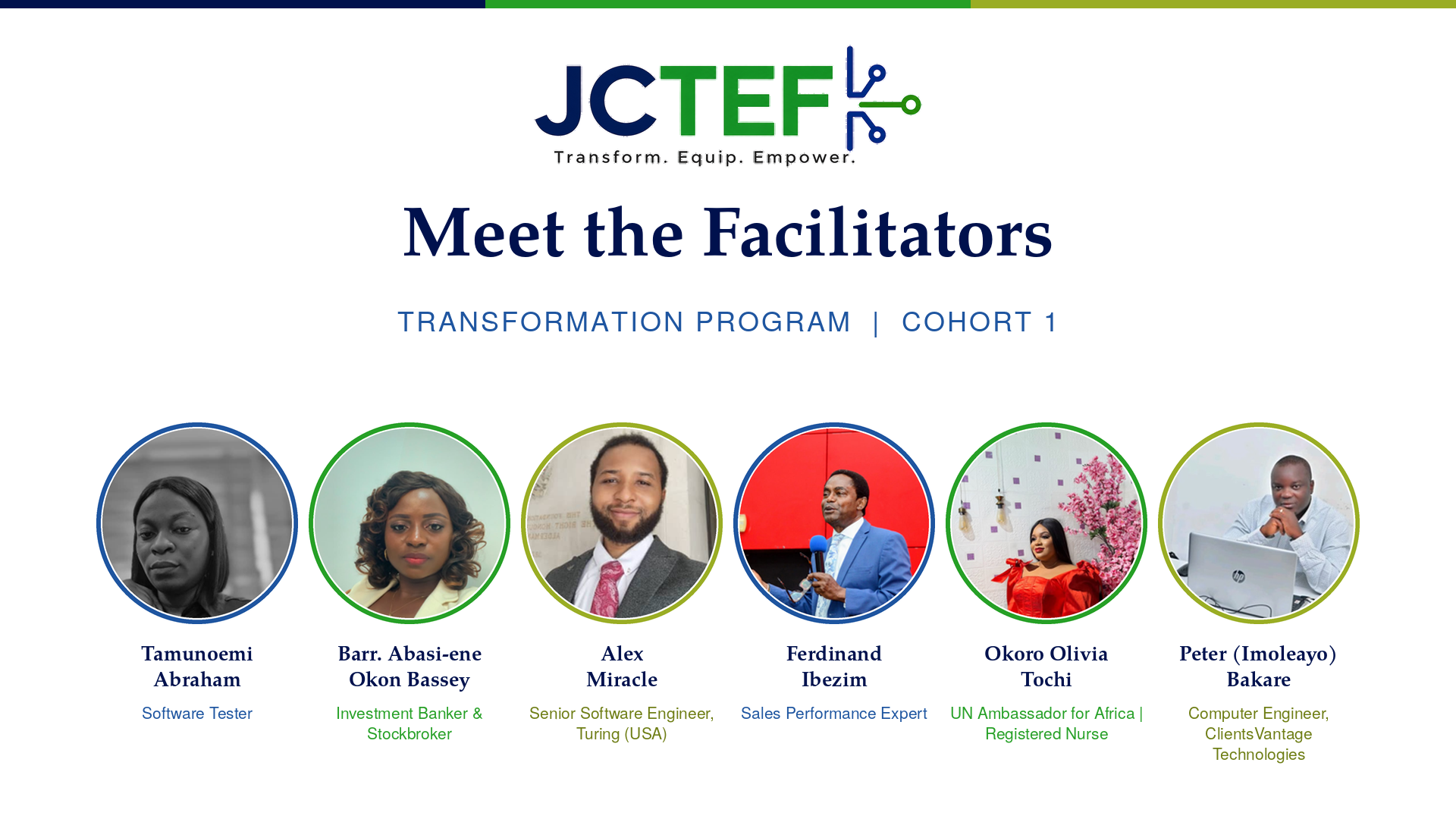
This was the focus of a yesterday session of the JCTEF Transformation Program, where our Fellows explored the principles of financial literacy and wealth creation under the guidance of Abasi-ene Bassey, LLB, BL, ACS, a Barrister with experience in investor relations, compliance, and stockbroking.
The session provided an opportunity for Fellows to examine their relationship with money, understand the importance of financial discipline, and learn practical principles for making more responsible financial decisions.
Beyond Earning: Understanding the Principles of Money
One of the central lessons from the session was that making money and managing money are two different skills.
An individual may earn a reasonable income and still experience persistent financial difficulties without proper planning, saving habits, and spending discipline. Similarly, increasing one’s income does not automatically guarantee financial stability or wealth creation.
Sustainable financial growth requires a deliberate approach to how money is earned, spent, saved, protected, and invested.
Through discussions on money, the principles of wealth generation, income, savings, and investment, Fellows were encouraged to think beyond immediate earnings and develop a more intentional approach to their finances.
The Importance of Financial Discipline
Financial discipline was one of the key takeaways from the session.
Managing money effectively begins with understanding one’s income, identifying essential expenses, setting financial priorities, and making deliberate spending decisions.
Rather than spending without a plan and saving whatever remains, individuals can develop a more sustainable approach by allocating their income according to their needs, responsibilities, and financial goals.
Financial discipline also involves resisting unnecessary spending, avoiding impulsive financial decisions, and recognising the difference between immediate desires and long-term priorities.
These habits may appear simple, but consistently practising them can make a significant difference in a person’s financial life.
Why Emergency Savings Matter
Unexpected expenses can create serious financial pressure, particularly when there is no money set aside to handle them.
An emergency fund provides a financial buffer for unforeseen situations, such as urgent repairs, unexpected medical bills, or temporary interruptions to income.
During the session, the importance of maintaining emergency savings stood out as a practical lesson in reducing financial vulnerability.
Having money reserved for emergencies can help individuals avoid borrowing under pressure, disrupting their long-term savings, or selling investments at an unfavourable time.
Building an emergency fund may take time, especially for people with limited income. However, starting with manageable amounts and saving consistently can help establish the habit.
The goal is not simply to accumulate money, but to create a measure of financial security that allows for better decision-making when unexpected circumstances arise.
Understanding Investment and Wealth Creation
Saving is important, but understanding how to put money to work is another part of financial literacy.
Fellows were introduced to different types of investment and the distinction between short-term and long-term investment approaches.
These approaches serve different purposes. Short-term investments may be suited to particular near-term financial objectives, while long-term investing may support goals that require more time to achieve.
However, investment decisions should never be based solely on the promise of high returns. Individuals need to consider their financial goals, time horizon, risk tolerance, liquidity needs, and understanding of the investment itself.
The session reinforced the importance of making informed decisions rather than following trends or investing simply because others are doing so.
Avoiding Get-Rich-Quick Schemes
The desire to achieve financial success quickly can make people vulnerable to unrealistic promises and fraudulent investment opportunities.
Schemes that guarantee unusually high returns with little or no risk should be approached with caution. Before committing money, investors should understand how an investment generates returns, verify the legitimacy of the provider, and assess the risks involved.
Wealth creation is not a process that should depend on desperation or blind trust. It requires patience, informed judgment, consistency, and an appreciation of the relationship between risk and potential reward.
Understanding Debt and Avoiding Financial Pressure
Debt can become a significant source of financial pressure when it is poorly managed or taken on without considering the consequences.
The session also addressed the importance of understanding debt and recognising the risks associated with borrowing.
Before taking a loan, individuals should carefully assess the purpose of the borrowing, the interest and other charges, the repayment schedule, and their ability to meet the obligations without compromising essential needs.
Avoiding unnecessary borrowing, understanding loan terms, and resisting pressure to maintain a lifestyle beyond one’s means are important steps towards protecting financial stability.
The objective is not to suggest that every form of borrowing is inherently bad, but to encourage thoughtful decisions that take account of both immediate needs and long-term consequences.
Diversification: Avoiding the Risk of Putting Everything in One Basket
Another important principle discussed during the session was diversification.
The familiar expression, “Don’t put all your eggs in one basket,” captures a fundamental idea in financial risk management: concentrating all one’s resources in a single investment or opportunity can increase exposure to loss.
Diversification involves spreading investments across different assets or opportunities, where appropriate, rather than depending entirely on one source.
For example, an investor may consider different investment categories based on their goals, resources, and risk profile. However, diversification does not eliminate risk or guarantee returns. It is a strategy for managing exposure and should be approached with proper understanding.
The wider lesson is to avoid making financial decisions based entirely on a single opportunity, popular opinion, or the promise of quick profit.
Financial Literacy and the Value of Income
Wealth creation also requires an understanding of value exchange: the relationship between the value a person provides and the income they earn.
Developing useful skills, solving problems, providing services, and creating products can expand opportunities to earn income. However, earning more must be accompanied by the ability to manage that income responsibly.
For young people seeking economic independence, this means working towards two complementary goals: developing the capacity to create value and developing the discipline to manage the financial rewards that follow.
Financial literacy therefore extends beyond budgeting and saving. It influences how people evaluate opportunities, manage uncertainty, plan for the future, and make decisions that affect their economic well-being.
Building Financially Responsible and Productive Young People
At the Jacob Chidimma Empowerment and Transformation Foundation (JCTEF), we recognise that human capital development involves more than acquiring academic qualifications or professional skills.
Young people also need the knowledge, attitudes, and practical abilities required to make responsible decisions in their personal and economic lives.
The JCTEF Transformation Program is designed to support this broader development through learning, reflection, practical engagement, and exposure to important life and career skills.
The financial literacy session was another step in that journey. It encouraged Fellows to examine their financial habits, understand the importance of preparation, and appreciate that long-term stability is built through informed decisions and consistent action.
Our philosophy remains clear: transformation precedes empowerment. When people develop the capacity to think critically, make better decisions, manage resources, and create value, they are better positioned to pursue opportunities and contribute meaningfully to society.
Appreciation to Our Facilitator
We sincerely appreciate Abasi-ene Bassey, LLB, BL, ACS, for sharing her knowledge and guiding our Fellows through this important subject.
Her contribution helped reinforce the value of financial awareness, disciplined money management, informed investing, and responsible financial decision-making.
We also appreciate our Fellows for their continued participation in the JCTEF Transformation Program and encourage them to put the lessons from this session into practice.
Conclusion: Financial Knowledge Must Become Financial Practice
Financial literacy is most valuable when knowledge translates into action.
Creating a budget, saving consistently, establishing an emergency fund, evaluating investment opportunities carefully, understanding debt, and managing financial risks are practical steps individuals can begin taking according to their circumstances.
There is no single financial strategy that works for everyone. What matters is developing the knowledge to make informed choices, the discipline to follow through, and the patience to build sustainable habits over time.
At JCTEF, we remain committed to helping young people move from dependency to productivity by equipping them with the knowledge, skills, and mindset needed to take greater responsibility for their futures.
Because earning money matters, but learning to manage it wisely is an essential part of building lasting financial stability and wealth.
Jacob Chidimma Empowerment and Transformation Foundation (JCTEF) — Human Capital Development and Transformation.