Preparing Young People for Global Opportunities: Lessons from JCTEF’s Session on Finding Fully Funded Scholarships
Date: October 10, 2026
Programme: JCTEF Transformation Program
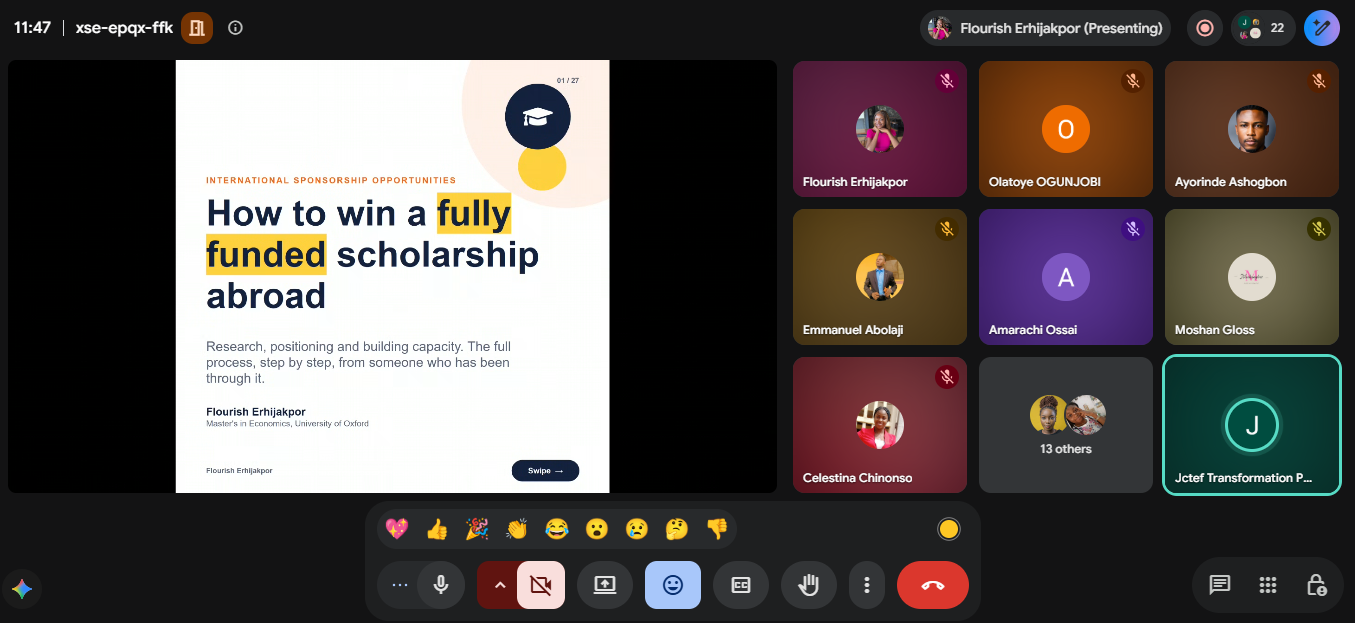
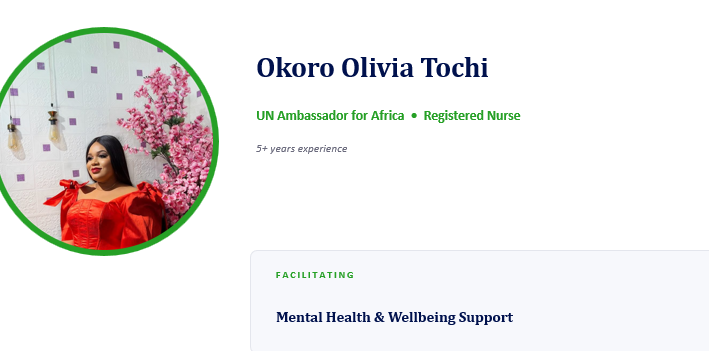
Guest Facilitator: Flourish Erhijakpor
Access to quality education can open doors to new possibilities, but for many young people, the cost of further education remains a significant barrier. Fully funded scholarships provide one pathway to overcoming this challenge. However, finding these opportunities, preparing competitive applications, and positioning oneself for success require more than ambition alone. They require the right information, preparation, and strategy.
Recognizing the importance of connecting young people with opportunities that can advance their personal and professional development, the Jacob Chidimma Empowerment and Transformation Foundation (JCTEF), through its Transformation Program, hosted a special learning session on Finding Fully Funded Scholarships on Saturday, October 10, 2026.
The session featured Flourish Erhijakpor, who shared valuable insights to help participants better understand international scholarship opportunities and the steps they can take to prepare for them.
Although the session was initially organized for Fellows of the JCTEF Transformation Program, the Foundation’s commitment to making valuable information more accessible informed the decision to extend the invitation to other interested young people.
Understanding the Possibilities of Fully Funded Scholarships
One of the important lessons from the session was that scholarship opportunities are not limited to a particular stage of education. Young people seeking undergraduate or postgraduate education can explore funding opportunities that align with their academic backgrounds, interests, and future aspirations.
However, knowing that these opportunities exist is only the beginning. Prospective applicants must also understand the requirements, identify suitable programmes, and prepare themselves to submit strong applications.
The session encouraged participants to approach scholarship opportunities intentionally rather than waiting until an application deadline is near before beginning their preparations.
Preparing Strategically for Scholarship Opportunities
A recurring message throughout the session was the importance of preparation.
Securing a scholarship is not simply about discovering an opportunity and submitting an application. Applicants must pay attention to eligibility criteria, application requirements, deadlines, supporting documents, and the specific expectations of each scholarship programme.
Young people were encouraged to research opportunities carefully and prepare in advance. This includes understanding the academic requirements of their chosen programmes, identifying relevant experiences, and ensuring that their applications communicate their strengths and aspirations effectively.
Strategic preparation helps applicants make informed decisions about where to apply and how to present themselves.
Writing a Strong Personal Statement: Connecting Your Past, Present, and Future
A particularly valuable part of the session focused on writing stronger personal statements.
A personal statement gives applicants an opportunity to communicate who they are, what has shaped their journey, why they are pursuing a particular programme, and what they hope to accomplish in the future.
Flourish emphasized the importance of building a coherent narrative that connects an applicant’s past experiences, present direction, and future aspirations.
Rather than presenting unrelated achievements or simply stating a desire to study abroad, applicants should be able to explain how their academic background, experiences, interests, and goals connect with the programme they intend to pursue.
A compelling personal statement should help the reader understand:
- Your background: What experiences, interests, or circumstances have influenced your academic and professional journey?
- Your present direction: What are you working towards, and why have you chosen this particular field or programme?
- Your future aspirations: How will the opportunity contribute to your long-term goals?
- Your purpose: What do you hope to learn, contribute, or achieve through the programme?
The objective is not to manufacture an impressive story but to communicate a genuine, thoughtful, and well-structured account of one’s journey and ambitions.
Building Relationships and Maintaining Professional Connections
Another important lesson concerned the role of relationships in academic and professional development.
Scholarship applications may require references from lecturers, supervisors, employers, or other individuals who can speak credibly about an applicant’s abilities, character, and potential.
Flourish encouraged young people to build cordial and professional relationships with their lecturers and people they work with. Such relationships should be built through respectful communication, responsible conduct, consistency, and a genuine commitment to learning and contributing.
Applicants should not wait until they need a recommendation letter before establishing these connections. Instead, they should cultivate professional relationships throughout their academic and career journeys.
A strong reference is more meaningful when the person providing it has had sufficient opportunity to observe and understand the applicant’s qualities and work.
Excellence Matters: Do Your Best in Whatever You Do
Beyond scholarship applications, the session reinforced a principle that applies to every area of personal and professional development: pursue excellence in whatever you do.
Young people were encouraged to take their responsibilities seriously and give their best to the tasks before them.
Academic assignments, workplace responsibilities, volunteer engagements, personal projects, and other learning experiences can all contribute to the development of valuable skills and demonstrate an individual’s commitment.
Not every opportunity will immediately lead to a scholarship, a job, or another desired outcome. Nevertheless, approaching responsibilities with diligence helps build competence, discipline, and a stronger foundation for future opportunities.
Preparation is not always visible, but it can make a difference when the right opportunity arrives.
Learning Foreign Languages and Expanding Your Global Readiness
The discussion also highlighted the potential value of learning foreign languages.
As young people explore international education and career opportunities, the ability to communicate across languages and cultures can be an advantage. Depending on the destination, programme, or career path, proficiency in another language may support communication, cultural understanding, and integration into a new environment.
Participants were encouraged to consider language learning as part of their broader personal development.
While language requirements differ across institutions and scholarship programmes, developing this skill can help young people prepare for an increasingly interconnected world.
The Power of Trying: Increasing Your Chances Through Action
One of the most memorable lessons from the session was the importance of continuing to try.
The more opportunities you explore and pursue strategically, the more chances you create to achieve the outcome you desire.
This does not mean submitting applications carelessly or applying for every opportunity without considering eligibility. Rather, it means refusing to let fear, uncertainty, or an unsuccessful application become a permanent barrier to progress.
A rejected application can provide an opportunity to review your approach, strengthen your documents, identify gaps, and prepare better for the next opportunity.
Young people must learn to combine persistence with reflection, preparation, and continuous improvement.
The goal is not merely to apply more often but to become better prepared with every attempt.
JCTEF’s Commitment to Human Capital Development
At JCTEF, we recognize that potential alone is not enough. Potential must be discovered, developed, disciplined, and directed.
Our approach to human capital development goes beyond encouraging young people to dream about a better future. We are intentional about providing learning experiences, practical guidance, exposure, and access to information that can help them take meaningful steps towards their aspirations.
The JCTEF Transformation Program brings young people through a structured development journey designed to strengthen their personal capacity, expand their knowledge, improve their readiness for opportunities, and encourage greater responsibility for their growth.
The session on Finding Fully Funded Scholarships reflects this commitment. By connecting our Fellows with relevant knowledge and experienced individuals, we aim to help them move from simply knowing that opportunities exist to understanding how to prepare for and pursue them.
We also recognize that valuable information should not stop at the boundaries of a programme. Extending access to other interested young people reflects our belief that knowledge and exposure can contribute to broader transformation.
Final Thoughts
International scholarship opportunities can provide pathways to further education, professional development, and wider global exposure. However, young people must be willing to prepare, research carefully, develop relevant skills, build meaningful relationships, and pursue opportunities with persistence.
The insights shared during this session serve as a reminder that progress often begins long before an application is submitted. It begins with how we approach our responsibilities, how intentionally we prepare, and how willing we are to learn from each experience.
We appreciate Flourish Erhijakpor for sharing her knowledge and practical insights with the JCTEF Transformation Program Fellows.
As we continue this journey, our message to young people remains clear: seek knowledge, prepare intentionally, pursue excellence, and keep taking meaningful steps towards your goals.
At JCTEF, we believe that transformation precedes empowerment, and human transformation creates economic transformation.
Learn more about the JCTEF Transformation Program and our human capital development initiatives at jctef.org.